
Please excuse the following rant. According to the latest numbers, about 14.2 million students are enrolled in an undergraduate program. Best Colleges (1) That means 3.55 million students will be applying to college this year. That is 3.55 million students and their parents worried about grades, SAT / ACT scores, extracurricular activities, college essays, recommendations, and interviews. Millions of high school students competing with each other for admissions, scholarships, grants, and loans. As parents and for our children, the entire process seems designed to maximize stress.
What are we teaching our kids? That it is good to isolate and ruthlessly outcompete their peers and leave people behind? To value the individual over all of society? To become a mindless automaton in a mindless system? To sacrifice their mental and physical health so they can brag what college they got into? To work on passion projects where it’s a resume item and not a real passion?
To get into a college, it requires a lot of preparation. That preparation costs money many times. College will require loans. The hope is we join some college, gain valuable insight and thinking capacity, demonstrate skills in a world that needs them, allowing us to join a corporation that maximizes how much we make, all to pay off our loans.
High school – major studying and activity stress to get into college. Lots of work. Covered by property or income taxes.
College – more laid back atmosphere, where you choose your classes and schedule. Decent amount of work. Goal is to think, learn, and apply your skills. Pay to attend. Can be paid for through grants, work study, scholarships, and loans.
Work – Get paid to do activities useful to someone else, including soul-less corporations that extract resources, destroy the environment and hate organized labor resistance. Work includes B corps, non-profits and governments, teachers, nurses, child care workers and firefighters, work that doesn’t pay the greatest, but valuable to society at large. Until recently, many positions required a college degree. It’s easier to get a job with a labor shortage than to get into college.
Something in this system doesn’t add up.
The average federal student loan debt is $37,338 per borrower. Private student loan debt averages $54,921 per borrower. The average student borrows over $30,000 to pursue a bachelor’s degree. A total of 45.3 million borrowers have student loan debt; 92% of them have federal loan debt.
Education Data (2)
Some quick math. If all 3.55 million students joining college this year take the average of $30,000 in student loans, the value of those student loans when they graduate is about $106.5 billion every year. That’s a large incentive for financiers to minimize college supply and maximize college demand. When was the last time a new college was created? Why shouldn’t everyone with the aptitude for higher studies get a chance, even if they can’t afford it? How do we help those without an aptitude for higher studies? How do we ensure accountability for these loans actually provides value? As a society, doesn’t it make sense to maximize the potential, talent and opportunities of everyone, rather than maximize the wealth and opportunities of a handful of billionaires?
US News and World report has a page per college where they breakdown Financial Aid Statistics. Here’s MIT, which is generous with financial aid.

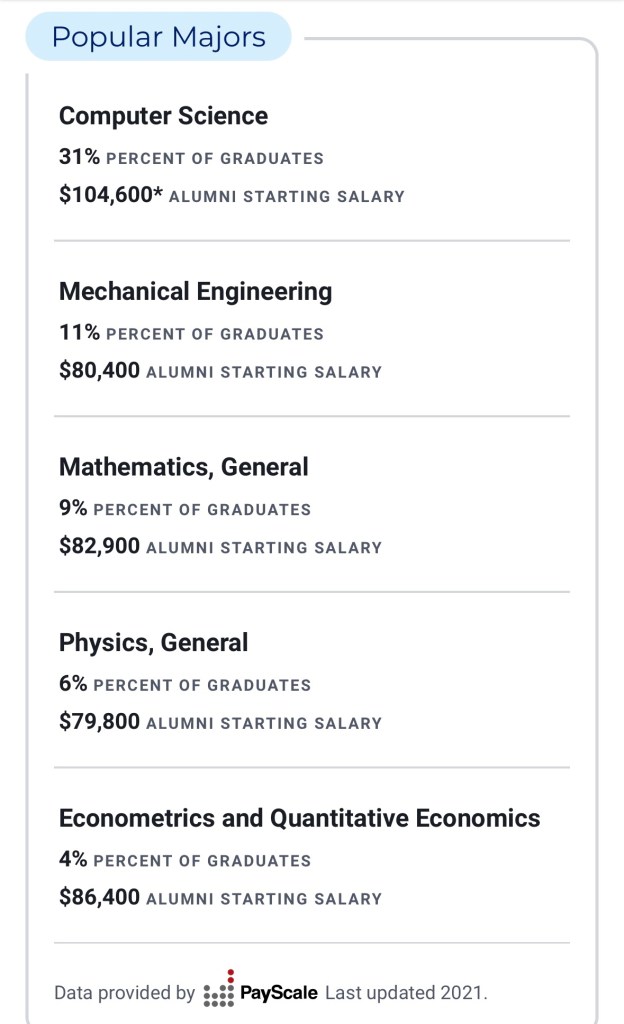
A reason why people want to go to MIT, outside the prestige and relationships: the starting alumni salaries are well above the national average. About 1000 people start an MIT undergraduate degree every year. That leaves 3,549,000 million people looking elsewhere. That demand flows down to other schools in a mad rush. Demand flows to schools that are not as generous as MIT, with lower financial aid, lower graduation rates, lower starting alumni salaries, and higher student debt.
As a coach for my work teams, we emphasize teamwork, frequent communication, openness to feedback, helping others, and continuous learning. The frenzy of college admissions, the focus on individual achievements over common solutions, competing with others over useless school ranks, the isolation of studies versus the camaraderie of teams, it is the opposite of what takes place at work and in life.
We have many global problems, requiring people to work together across geographies and nationalities. We have too many rich people with big egos, saying the individual is greater than the whole, that more money at the expense of the Earth and civilization is a useful endeavor. I can’t reconcile both environments. Is the college rat race frenzy and heartache worth it for students and parents? Too many of us give in to the race and say yes.
I’m almost of the mind to tell our children kpoplistener and themandalorian, do what you love at school and after school. Do your best on your grades without stressing yourself. Discover your talents by doing new, bold things. Help your community. Enjoy your time. Make friends. Meet new people. Be yourself. Take care of your mental, physical, and emotional health. Things will take care of themselves when the time is right.
I don’t have solutions on the college admissions rat race. I know as a people, we can do better. Thanks for reading my rant.
Sincerely yours,
smilingdad
Notes:
(1) Best Colleges College Enrollment Statistics in the U.S. https://www.bestcolleges.com/research/college-enrollment-statistics/
(2) Education Data Average Student Loan Debt https://educationdata.org/average-student-loan-debt#:~:text=The%20average%20federal%20student%20loan,them%20have%20federal%20loan%20debt
(3) US News and World Report Massachusetts Institute of Technology https://www.usnews.com/best-colleges/massachusetts-institute-of-technology-2178
 smilingdad